 Add to Chrome
 Add to Firefox
 Add to Edge
Beyond Scalar Objectives: Expert-Feedback-Driven Autonomous Experimentation for Scientific Discovery at the Nanoscale
May 20, 2026
Self-driving laboratories or autonomous experimentation are emerging as transformative platforms for accelerating scientific discovery. Bayesian optimization (BO) is among the most widely used machine learning frameworks for these purposes, but these BO-based frameworks rely on predefined scalar descriptors to guide experimentation. In many situations, the determination of an appropriate scalar descriptor can be challenging, and may fail to capture subtle yet scientifically important phenomena apparent to experts with interdisciplinary insight. To overcome this limitation, here we develop deep-kernel pairwise learning (DKPL), an approach for autonomous microscopy experiments which incorporates human expertise and interdisciplinary scientific knowledge into an active learning loop. Instead of relying on explicit scalar objectives, DKPL enables experts to directly evaluate which experimental output is more promising using interdisciplinary knowledge. DKPL then learns a latent utility function from these expert judgements to guide subsequent autonomous microscopy experiments. We demonstrate DKPL's performance in learning physically meaningful nanoscale structures while effectively prioritizing high-information measurement regions using an experimental model dataset with known ground truth. We further apply DKPL to analyze the character of ferroelectric domain walls, where we find DKPL capable of distinguishing between high and low characteristic domain-wall angles in bismuth ferrite, and able to discover both head-to-head and tail-to-tail domain-wall character in erbium manganite. This development establishes an approach to integrate expert knowledge into autonomous microscopy experiments and demonstrates a pathway toward expert-guided self-driving laboratories capable of addressing scientific problems beyond the limits of scalar-metrics-driven learning.

Quality-Controlled Active Learning via Gaussian Processes for Robust Structure-Property Learning in Autonomous Microscopy
Mar 31, 2026Autonomous experimental systems are increasingly used in materials research to accelerate scientific discovery, but their performance is often limited by low-quality, noisy data. This issue is especially problematic in data-intensive structure-property learning tasks such as Image-to-Spectrum (Im2Spec) and Spectrum-to-Image (Spec2Im) translations, where standard active learning strategies can mistakenly prioritize poor-quality measurements. We introduce a gated active learning framework that combines curiosity-driven sampling with a physics-informed quality control filter based on the Simple Harmonic Oscillator model fits, allowing the system to automatically exclude low-fidelity data during acquisition. Evaluations on a pre-acquired dataset of band-excitation piezoresponse spectroscopy (BEPS) data from PbTiO3 thin films with spatially localized noise show that the proposed method outperforms random sampling, standard active learning, and multitask learning strategies. The gated approach enhances both Im2Spec and Spec2Im by handling noise during training and acquisition, leading to more reliable forward and inverse predictions. In contrast, standard active learners often misinterpret noise as uncertainty and end up acquiring bad samples that hurt performance. Given its promising applicability, we further deployed the framework in real-time experiments on BiFeO3 thin films, demonstrating its effectiveness in real autonomous microscopy experiments. Overall, this work supports a shift toward hybrid autonomy in self-driving labs, where physics-informed quality assessment and active decision-making work hand-in-hand for more reliable discovery.
Human-AI Collaborative Autonomous Experimentation With Proxy Modeling for Comparative Observation
Mar 13, 2026Optimization for different tasks like material characterization, synthesis, and functional properties for desired applications over multi-dimensional control parameters need a rapid strategic search through active learning such as Bayesian optimization (BO). However, such high-dimensional experimental physical descriptors are complex and noisy, from which realization of a low-dimensional mathematical scalar metrics or objective functions can be erroneous. Moreover, in traditional purely data-driven autonomous exploration, such objective functions often ignore the subtle variation and key features of the physical descriptors, thereby can fail to discover unknown phenomenon of the material systems. To address this, here we present a proxy-modelled Bayesian optimization (px-BO) via on-the-fly teaming between human and AI agents. Over the loop of BO, instead of defining a mathematical objective function directly from the experimental data, we introduce a voting system on the fly where the new experimental outcome will be compared with existing experiments, and the human agents will choose the preferred samples. These human-guided comparisons are then transformed into a proxy-based objective function via fitting Bradley-Terry (BT) model. Then, to minimize human interaction, this iteratively trained proxy model also acts as an AI agent for future surrogate human votes. Finally, these surrogate votes are periodically validated by human agents, and the corrections are then learned by the proxy model on-the-fly. We demonstrated the performance of the proposed px-BO framework into simulated and BEPS data generated from PTO sample. We find that our approach provided better control of the domain experts for an improved search over traditional data-driven exploration, thus, signifies the importance of human-AI teaming in an accelerated and meaningful material space exploration.
RFAssigner: A Generic Label Assignment Strategy for Dense Object Detection
Jan 03, 2026Label assignment is a critical component in training dense object detectors. State-of-the-art methods typically assign each training sample a positive and a negative weight, optimizing the assignment scheme during training. However, these strategies often assign an insufficient number of positive samples to small objects, leading to a scale imbalance during training. To address this limitation, we introduce RFAssigner, a novel assignment strategy designed to enhance the multi-scale learning capabilities of dense detectors. RFAssigner first establishes an initial set of positive samples using a point-based prior. It then leverages a Gaussian Receptive Field (GRF) distance to measure the similarity between the GRFs of unassigned candidate locations and the ground-truth objects. Based on this metric, RFAssigner adaptively selects supplementary positive samples from the unassigned pool, promoting a more balanced learning process across object scales. Comprehensive experiments on three datasets with distinct object scale distributions validate the effectiveness and generalizability of our method. Notably, a single FCOS-ResNet-50 detector equipped with RFAssigner achieves state-of-the-art performance across all object scales, consistently outperforming existing strategies without requiring auxiliary modules or heuristics.
Human-AI collaborative autonomous synthesis with pulsed laser deposition for remote epitaxy
Nov 14, 2025Autonomous laboratories typically rely on data-driven decision-making, occasionally with human-in-the-loop oversight to inject domain expertise. Fully leveraging AI agents, however, requires tightly coupled, collaborative workflows spanning hypothesis generation, experimental planning, execution, and interpretation. To address this, we develop and deploy a human-AI collaborative (HAIC) workflow that integrates large language models for hypothesis generation and analysis, with collaborative policy updates driving autonomous pulsed laser deposition (PLD) experiments for remote epitaxy of BaTiO$_3$/graphene. HAIC accelerated the hypothesis formation and experimental design and efficiently mapped the growth space to graphene-damage. In situ Raman spectroscopy reveals that chemistry drives degradation while the highest energy plume components seed defects, identifying a low-O$_2$ pressure low-temperature synthesis window that preserves graphene but is incompatible with optimal BaTiO$_3$ growth. Thus, we show a two-step Ar/O$_2$ deposition is required to exfoliate ferroelectric BaTiO$_3$ while maintaining a monolayer graphene interlayer. HAIC stages human insight with AI reasoning between autonomous batches to drive rapid scientific progress, providing an evolution to many existing human-in-the-loop autonomous workflows.
Gaussian Combined Distance: A Generic Metric for Object Detection
Oct 31, 2025In object detection, a well-defined similarity metric can significantly enhance model performance. Currently, the IoU-based similarity metric is the most commonly preferred choice for detectors. However, detectors using IoU as a similarity metric often perform poorly when detecting small objects because of their sensitivity to minor positional deviations. To address this issue, recent studies have proposed the Wasserstein Distance as an alternative to IoU for measuring the similarity of Gaussian-distributed bounding boxes. However, we have observed that the Wasserstein Distance lacks scale invariance, which negatively impacts the model's generalization capability. Additionally, when used as a loss function, its independent optimization of the center attributes leads to slow model convergence and unsatisfactory detection precision. To address these challenges, we introduce the Gaussian Combined Distance (GCD). Through analytical examination of GCD and its gradient, we demonstrate that GCD not only possesses scale invariance but also facilitates joint optimization, which enhances model localization performance. Extensive experiments on the AI-TOD-v2 dataset for tiny object detection show that GCD, as a bounding box regression loss function and label assignment metric, achieves state-of-the-art performance across various detectors. We further validated the generalizability of GCD on the MS-COCO-2017 and Visdrone-2019 datasets, where it outperforms the Wasserstein Distance across diverse scales of datasets. Code is available at https://github.com/MArKkwanGuan/mmdet-GCD.
Mic-hackathon 2024: Hackathon on Machine Learning for Electron and Scanning Probe Microscopy
Jun 10, 2025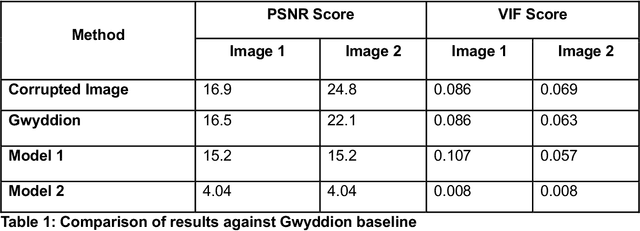

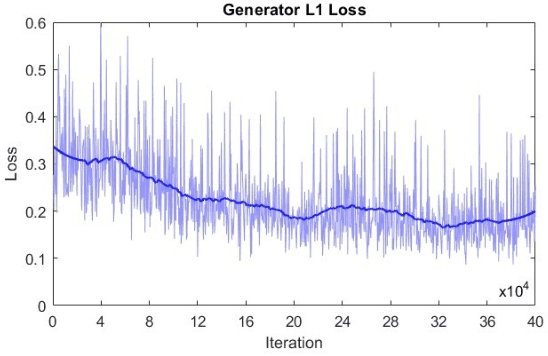
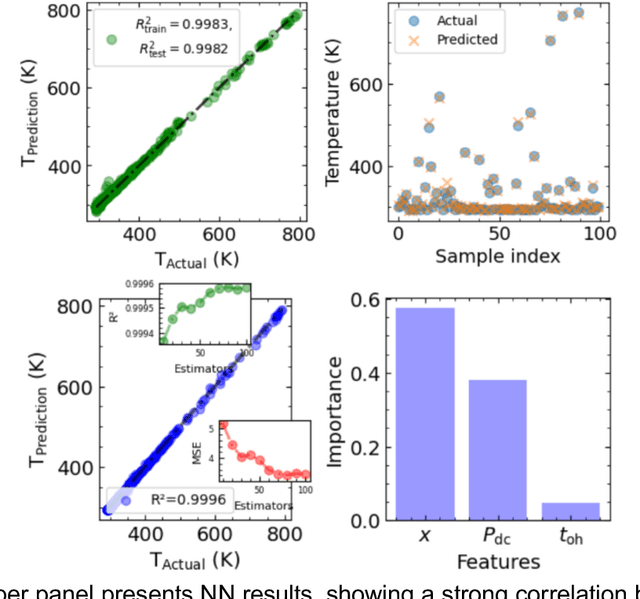
Microscopy is a primary source of information on materials structure and functionality at nanometer and atomic scales. The data generated is often well-structured, enriched with metadata and sample histories, though not always consistent in detail or format. The adoption of Data Management Plans (DMPs) by major funding agencies promotes preservation and access. However, deriving insights remains difficult due to the lack of standardized code ecosystems, benchmarks, and integration strategies. As a result, data usage is inefficient and analysis time is extensive. In addition to post-acquisition analysis, new APIs from major microscope manufacturers enable real-time, ML-based analytics for automated decision-making and ML-agent-controlled microscope operation. Yet, a gap remains between the ML and microscopy communities, limiting the impact of these methods on physics, materials discovery, and optimization. Hackathons help bridge this divide by fostering collaboration between ML researchers and microscopy experts. They encourage the development of novel solutions that apply ML to microscopy, while preparing a future workforce for instrumentation, materials science, and applied ML. This hackathon produced benchmark datasets and digital twins of microscopes to support community growth and standardized workflows. All related code is available at GitHub: https://github.com/KalininGroup/Mic-hackathon-2024-codes-publication/tree/1.0.0.1
Curiosity Driven Exploration to Optimize Structure-Property Learning in Microscopy
Apr 28, 2025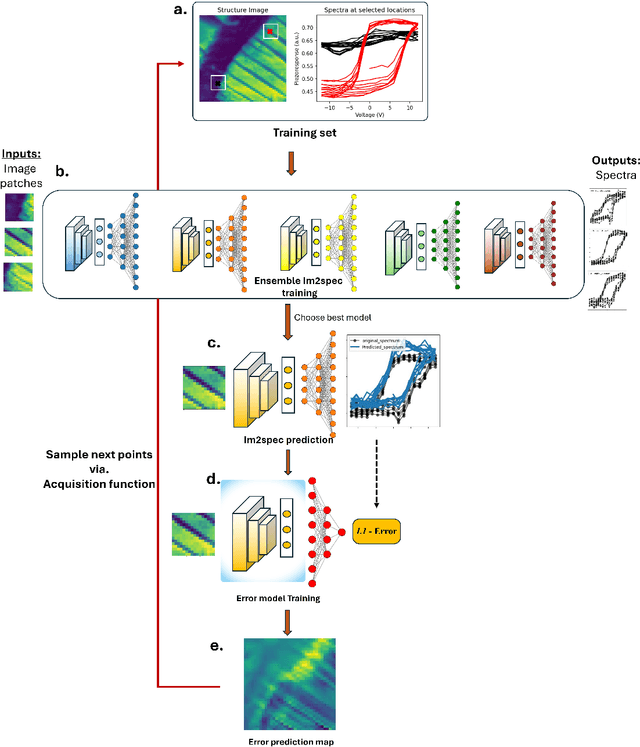
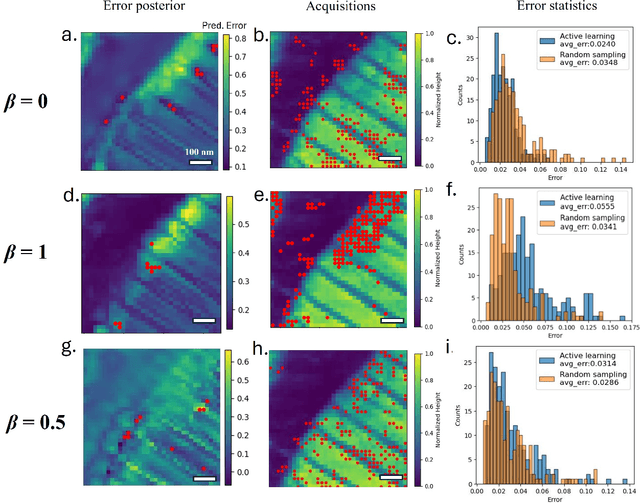
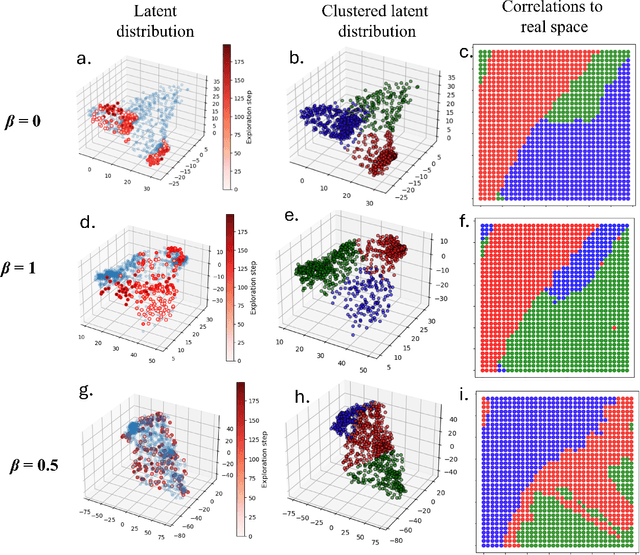
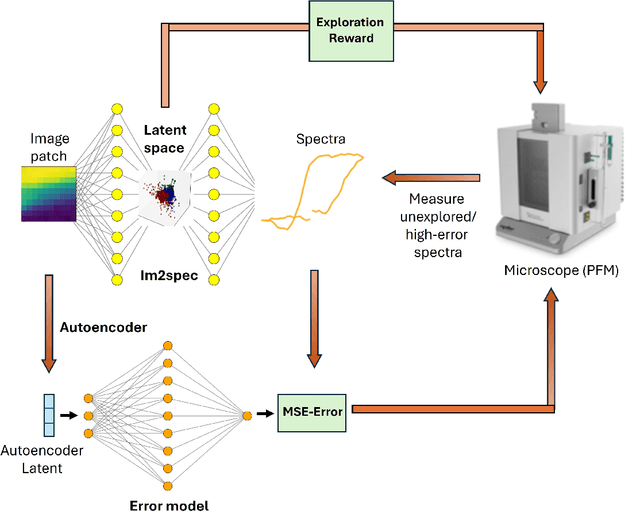
Rapidly determining structure-property correlations in materials is an important challenge in better understanding fundamental mechanisms and greatly assists in materials design. In microscopy, imaging data provides a direct measurement of the local structure, while spectroscopic measurements provide relevant functional property information. Deep kernel active learning approaches have been utilized to rapidly map local structure to functional properties in microscopy experiments, but are computationally expensive for multi-dimensional and correlated output spaces. Here, we present an alternative lightweight curiosity algorithm which actively samples regions with unexplored structure-property relations, utilizing a deep-learning based surrogate model for error prediction. We show that the algorithm outperforms random sampling for predicting properties from structures, and provides a convenient tool for efficient mapping of structure-property relationships in materials science.
Invariant Discovery of Features Across Multiple Length Scales: Applications in Microscopy and Autonomous Materials Characterization
Aug 01, 2024Physical imaging is a foundational characterization method in areas from condensed matter physics and chemistry to astronomy and spans length scales from atomic to universe. Images encapsulate crucial data regarding atomic bonding, materials microstructures, and dynamic phenomena such as microstructural evolution and turbulence, among other phenomena. The challenge lies in effectively extracting and interpreting this information. Variational Autoencoders (VAEs) have emerged as powerful tools for identifying underlying factors of variation in image data, providing a systematic approach to distilling meaningful patterns from complex datasets. However, a significant hurdle in their application is the definition and selection of appropriate descriptors reflecting local structure. Here we introduce the scale-invariant VAE approach (SI-VAE) based on the progressive training of the VAE with the descriptors sampled at different length scales. The SI-VAE allows the discovery of the length scale dependent factors of variation in the system. Here, we illustrate this approach using the ferroelectric domain images and generalize it to the movies of the electron-beam induced phenomena in graphene and topography evolution across combinatorial libraries. This approach can further be used to initialize the decision making in automated experiments including structure-property discovery and can be applied across a broad range of imaging methods. This approach is universal and can be applied to any spatially resolved data including both experimental imaging studies and simulations, and can be particularly useful for exploration of phenomena such as turbulence, scale-invariant transformation fronts, etc.
Bayesian Co-navigation: Dynamic Designing of the Materials Digital Twins via Active Learning
Apr 19, 2024

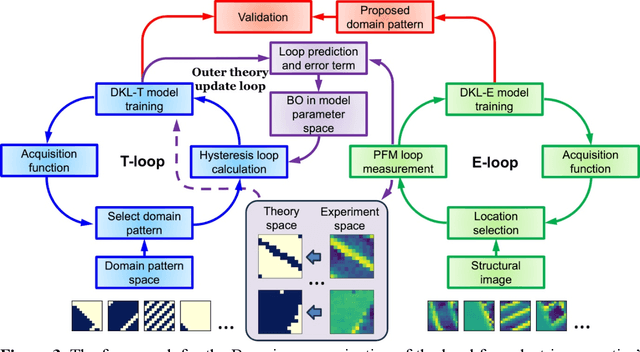
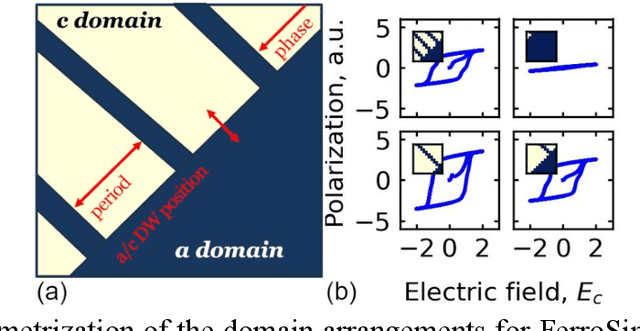
Scientific advancement is universally based on the dynamic interplay between theoretical insights, modelling, and experimental discoveries. However, this feedback loop is often slow, including delayed community interactions and the gradual integration of experimental data into theoretical frameworks. This challenge is particularly exacerbated in domains dealing with high-dimensional object spaces, such as molecules and complex microstructures. Hence, the integration of theory within automated and autonomous experimental setups, or theory in the loop automated experiment, is emerging as a crucial objective for accelerating scientific research. The critical aspect is not only to use theory but also on-the-fly theory updates during the experiment. Here, we introduce a method for integrating theory into the loop through Bayesian co-navigation of theoretical model space and experimentation. Our approach leverages the concurrent development of surrogate models for both simulation and experimental domains at the rates determined by latencies and costs of experiments and computation, alongside the adjustment of control parameters within theoretical models to minimize epistemic uncertainty over the experimental object spaces. This methodology facilitates the creation of digital twins of material structures, encompassing both the surrogate model of behavior that includes the correlative part and the theoretical model itself. While demonstrated here within the context of functional responses in ferroelectric materials, our approach holds promise for broader applications, the exploration of optical properties in nanoclusters, microstructure-dependent properties in complex materials, and properties of molecular systems. The analysis code that supports the funding is publicly available at https://github.com/Slautin/2024_Co-navigation/tree/main